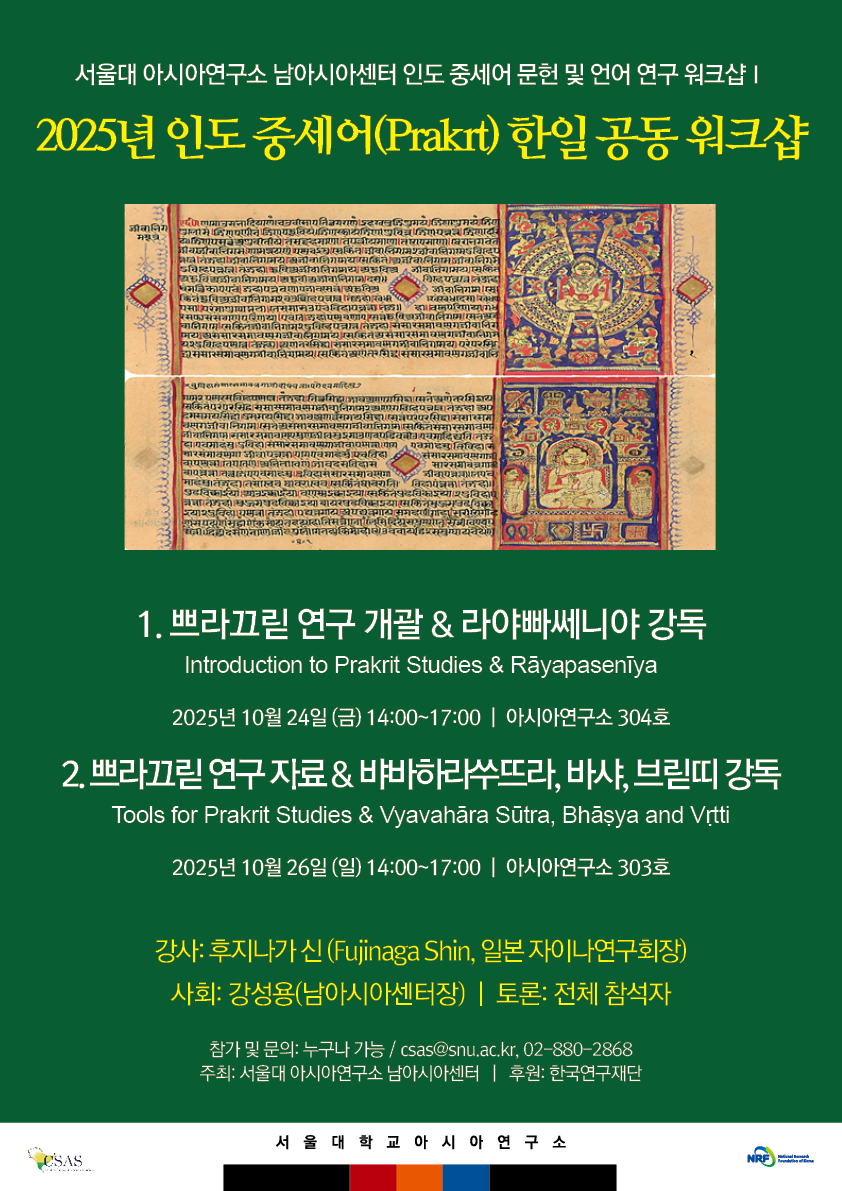
인도 문헌 및 언어 연구 워크샵 I _ 1.쁘라끄릳 연구 개괄 & 라야빠쎄니야 강독
October 27, 2025
Sanskrit Manuscripts of the Vajracchedikā Prajñāpāramitā kept at the Kōkiji Temple, Ōsaka
December 15, 2025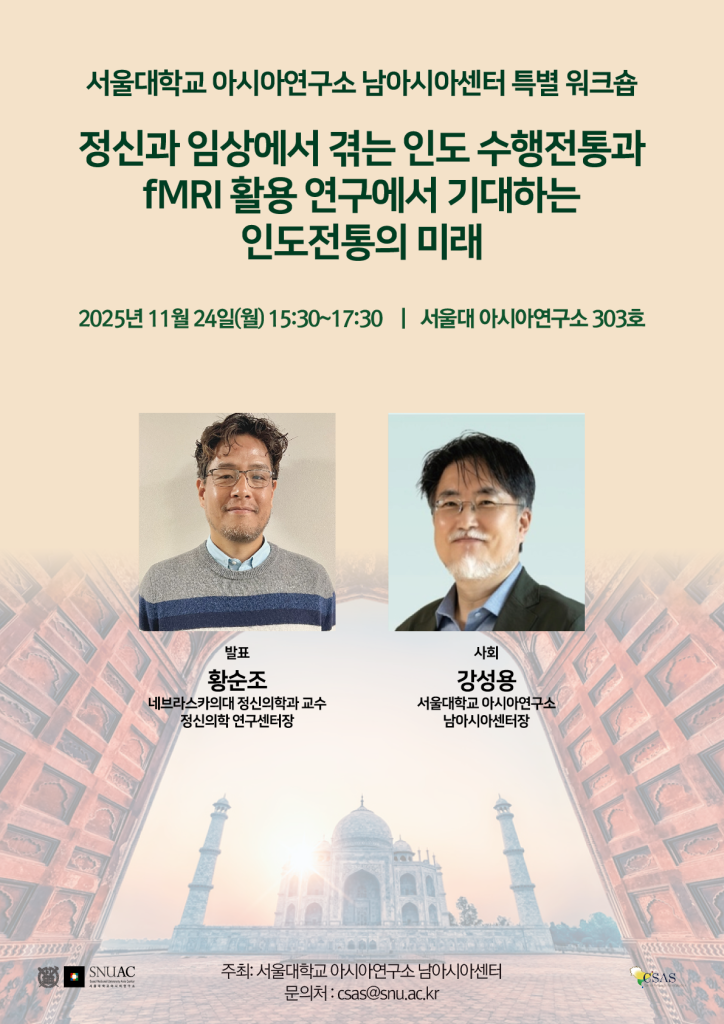
 Workshop Overview
While modern medicine has achieved remarkable advances, mental health challenges have grown to the point where their economic and social costs can be clearly quantified. In response, the National Institute of Mental Health (NIMH) has sought to move beyond symptom-based diagnostic frameworks such as the DSM toward a new paradigm grounded in biological characteristics, known as the Research Domain Criteria (RDoC).
At the same time, therapeutic practices rooted in Indian contemplative traditions, including meditation and breathing techniques, have become widely used in clinical settings. Programs such as Mindfulness-Based Stress Reduction (MBSR) and Mindfulness-Based Cognitive Therapy (MBCT) have now entered everyday life through smartphone applications. As of March 2021, approximately 20,000 academic publications related to “mindfulness and meditation” had been published, with a sharp increase since the mid-2000s.
Despite this rapid expansion, there remains a significant lack of historical and cultural understanding of these therapeutic approaches. For example, although MBSR is often described as being rooted in “Buddhist tradition,” it is in fact closely connected to modern reform movements in Burmese Buddhism. Indian healing traditions have developed a rich and diverse range of therapeutic practices over more than two millennia, yet this intellectual and cultural heritage has not been adequately examined in contemporary clinical discourse.
To address this gap, Professor SoonJo Hwang of the University of Nebraska Medical Center and Professor Sung Yong Kang of Seoul National University are pursuing an international collaborative research project. The Korean research team is reassessing the historical development of Indian healing traditions through close analysis of primary texts, while the U.S. team is investigating the neuroscientific effects of contemplative practices using methods such as fMRI. A pilot collaborative study is currently underway, with manuscripts under peer review, and a full research proposal has been submitted to the U.S. National Institutes of Health (NIH).
In connection with this project, the South Asia Center of the Asia Center at Seoul National University will host a workshop to foster interdisciplinary dialogue and scholarly exchange. We warmly invite interested scholars and participants to join us.
Photo

Review
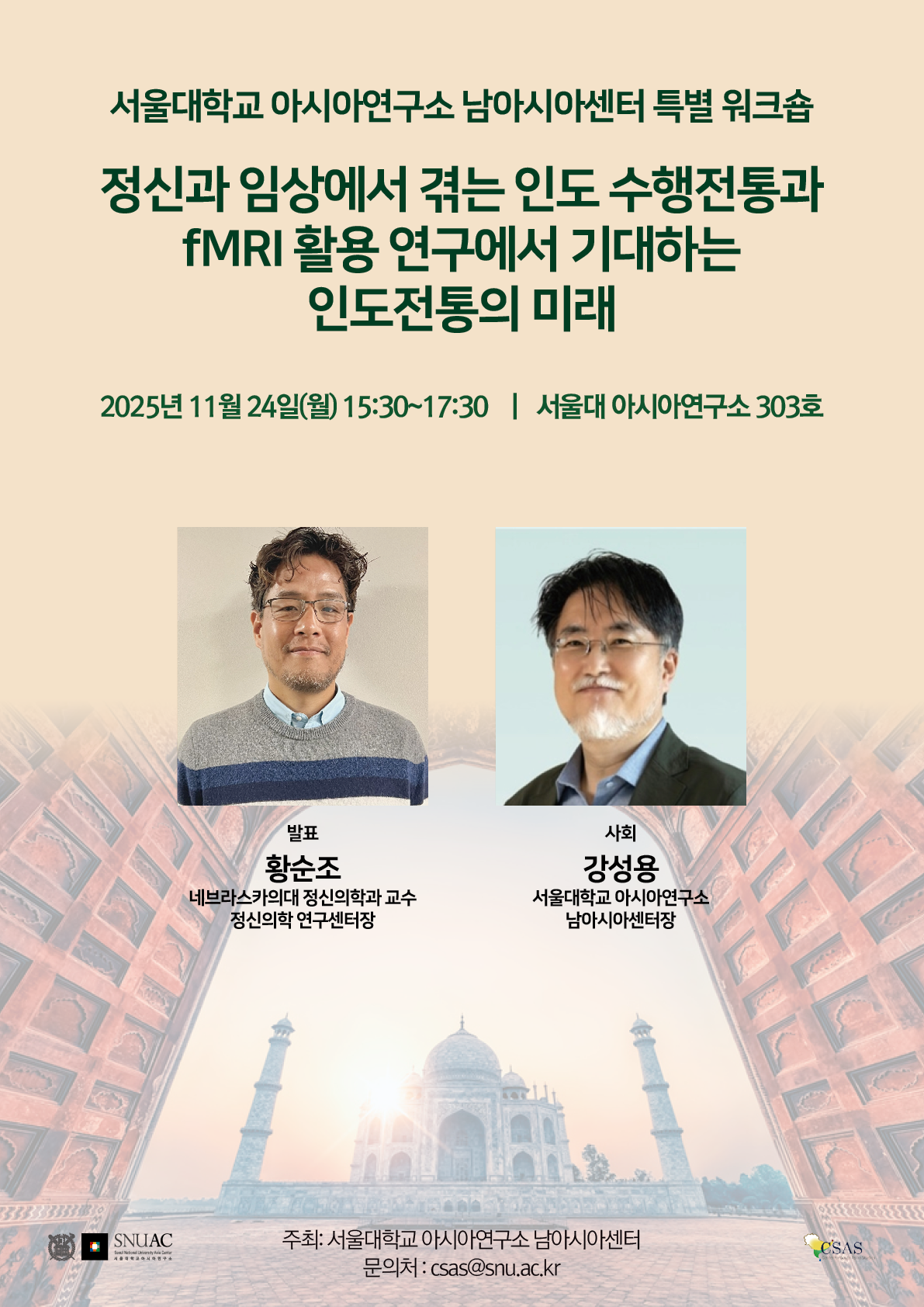
On November 24, 2025, the South Asia Center at the Asia Center of Seoul National University hosted a special workshop featuring Professor Soon-Jo Hwang, Professor of Psychiatry and Director of the Psychiatric Research Center at the University of Nebraska Medical Center. The workshop was titled “Indian Contemplative Traditions in Psychiatric Practice and the Future of Indian Traditions in fMRI-Based Research.”
At present, meditation techniques derived from Indian contemplative traditions—including mindfulness-based practices—are widely employed in psychiatric treatment. However, these techniques are often applied without sufficient clarification of their original purposes and effects, or of how Buddhist conceptual frameworks relate to contemporary psychiatric concepts. As a result, it remains difficult to conduct rigorous psychiatric research on Indian meditation practices that is firmly grounded in the doctrinal, historical, and practical contexts found in Buddhist texts and contemplative manuals.
In this workshop, Professor Hwang addressed this gap by adopting a neutral and methodologically reflective stance—neither rejecting nor uncritically embracing the religious dimensions of Buddhism. He explored how meditation methods and experiential accounts presented in Buddhist contemplative literature can be translated into medical and psychiatric research frameworks. In particular, he outlined his research agenda aimed at empirically examining these practices through the use of fMRI, with the goal of bridging classical contemplative traditions and contemporary neuroscience.
The workshop provided an important interdisciplinary forum for discussing how Indian contemplative traditions might be more rigorously and responsibly integrated into psychiatric research, while respecting both their historical depth and scientific applicability.