Experiencing Indian Meditative Traditions in Psychiatric Clinical Practice and Envisioning Their Future through fMRI Research
December 15, 2025인생의 깨달음과 괴로움 1부 | 강성용(인문학자) | 화요열린강좌 ‘왜 여전히 불교인가’ | 출가 문화 세계관 인도 가족 권위 언어 관점 이해 시야 집착
May 18, 2026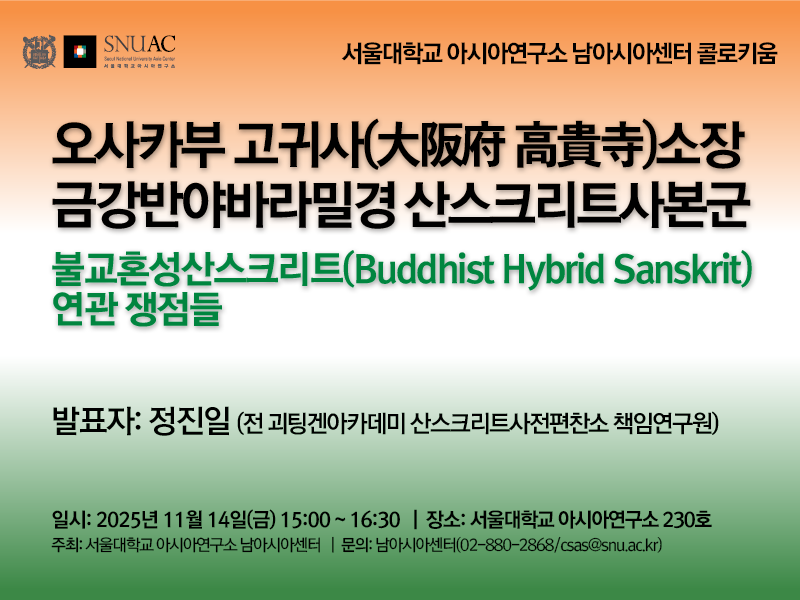

Colloquium Overview
This study focuses primarily on the Sanskrit manuscript corpus of the Vajracchedikā Prajñāpāramitā Sūtra preserved at Kōkiji Temple, Ōsaka, examining its chronological relationships—both anterior and posterior, as well as relative “older–newer” strata—in comparison with other extant manuscripts. Through a palaeographic approach, the study seeks to estimate the dating of these materials, while also closely analyzing linguistic and terminological transformations observable across the manuscript tradition.
Photo

Review
The Middle Indo-Aryan Studies project currently underway at the South Asia Center examines the diverse linguistic features of Middle Indo-Aryan languages, which emerged during a formative period in Indian cultural history. Middle Indo-Aryan encompasses a wide range of languages, one of which is Saṃskṛtam as employed in Buddhist literature. This linguistic form, commonly referred to as Buddhist Hybrid Sanskrit, is morphologically close to Classical Sanskrit while simultaneously preserving features characteristic of Middle Indo-Aryan or Prakṛt languages.
Many Abhidharma texts and early Mahāyāna Buddhist scriptures were composed in this linguistic register. As introduced by Dr. Jinil Jung during the colloquium, the Vajracchedikā Prajñāpāramitā Sūtra (hereafter, the Diamond Sūtra) contains numerous traces of Buddhist Hybrid Sanskrit.
Since Max Müller published the Diamond Sūtra in 1881, the text has undergone multiple translations and philological revisions. Building on this scholarly legacy, Dr. Jung is currently preparing a new critical edition of the Diamond Sūtra based on a Buddhist Hybrid Sanskrit manuscript preserved at Kōkiji Temple, Ōsaka—a manuscript that Müller did not consult. His work involves systematic comparison with existing editions and prior research.
During the workshop, Dr. Jung traced the historical lineage of the Gogwisa manuscript to the ninth-century copying activities initiated by the Japanese monk Ennin (圓仁), offering an overview of the broader tradition of scriptural transcription (寫經). He also highlighted textual variations among different manuscript witnesses and presented concrete examples illustrating the linguistic features of Buddhist Hybrid Sanskrit.
In addition, Dr. Jung introduced ongoing international research on the Diamond Sūtra, including projects led by scholars such as Paul Harrison, and guided how to effectively engage with research outputs published by overseas academic institutions.