인도가 이제 ‘돈 버는 시장’인 결정적 증거 [강성용의 남아시아 인사이드]
May 18, 2026
Roundtable Discussion on Collaborative Initiatives Between University of Nebraska Medical Center (UNMC) and the SNUAC Center for South Asian Studies
June 21, 2026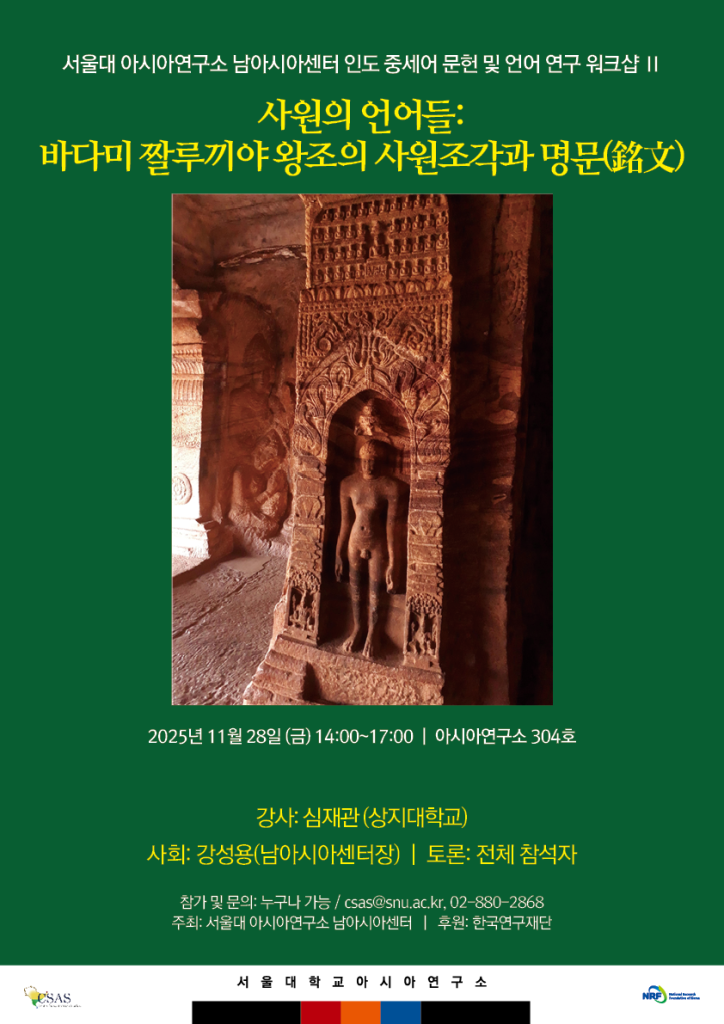
The Center for South Asian Studies will hold the second workshop in its series on Medieval Indian Texts and Languages. This workshop will examine Indian temples and the medieval languages inscribed on them. Professor Jae Kwan Shim of Sangji University, a distinguished scholar in this field in Korea, will lead the workshop under the title “Languages of the Temple: Temple Sculpture and Inscriptions of the Badami Chalukya Dynasty.”
In India, the temple sites in and around Badami, Karnataka, the early capital of the Chalukya dynasty from the sixth century onward, display a wide variety of architectural styles and sculptural works shaped by diverse religious backgrounds. The narrative sculptures found in these temples appear to have functioned not merely as decorative elements of architecture, but at times as a form of political language in themselves, depending on the manner in which they were created and arranged. In addition, these temples contain a number of inscriptions written in Sanskrit and Kannada, through which various forms of historical information can be examined.
Speaker: Jae Kwan Shim, Sangji University
Chair: Sung Yong Kang, Director of the Center for South Asian Studies
Discussion: All participants
Venue: Room 304, Seoul National University Asia Center
Date and Time: Friday, November 28, 2025, 14:00–17:00
Photos


Review
On November 28, 2025, the Center for South Asian Studies at the Seoul National University Asia Center held a workshop titled “Languages of the Temple: Temple Sculpture and Inscriptions of the Badami Chalukya Dynasty.” The lecture introduced the distinctive features of Chalukya temple architecture, in which northern and southern styles coexisted, with a particular focus on the Badami–Pattadakal–Aihole region, as well as how narrative sculpture was employed in temple spaces. It then examined the composition of inscriptional materials preserved in Sanskrit, Kannada, and Telugu, and analyzed the linguistic and scriptural environment of the period, including the concurrent use of Old Kannada script and Siddhamātrikā. By bringing temple architecture and inscriptions into an integrated perspective, the workshop provided a meaningful opportunity to deepen understanding of the cultural multiplicity of the Deccan region.